By Zeno · October 8, 2026 · 3 min read
The services our catalogue rates hardest to cancel
Zeno keeps a catalogue of 509 services and rates how each one is cancelled: easy, medium, hard, or a dark pattern. 14 are in the last two groups. This is who they are and what they do to you.
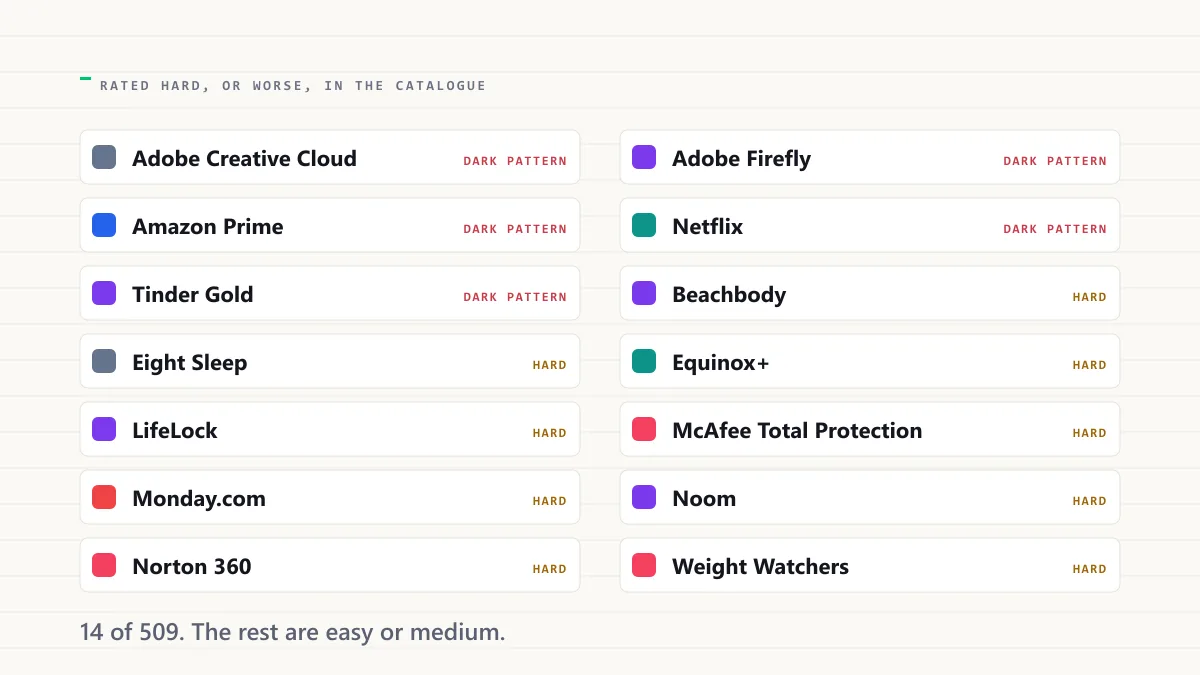
The rating is a judgement about the steps, not about the service. A service rates easy when the cancel button is where you expect it and there is one confirmation. Medium means a few screens and perhaps an offer. Hard means the path is long, hidden, or needs a phone call or chat. A dark pattern is a step whose only job is to stop you: a retention offer you must decline, a pause you did not ask for, a final screen designed to look like the end but is not.
Counted today, the catalogue has 124 easy, 371 medium, 9 hard, and 5 dark pattern. That is 3 percent in the two groups below.
The list
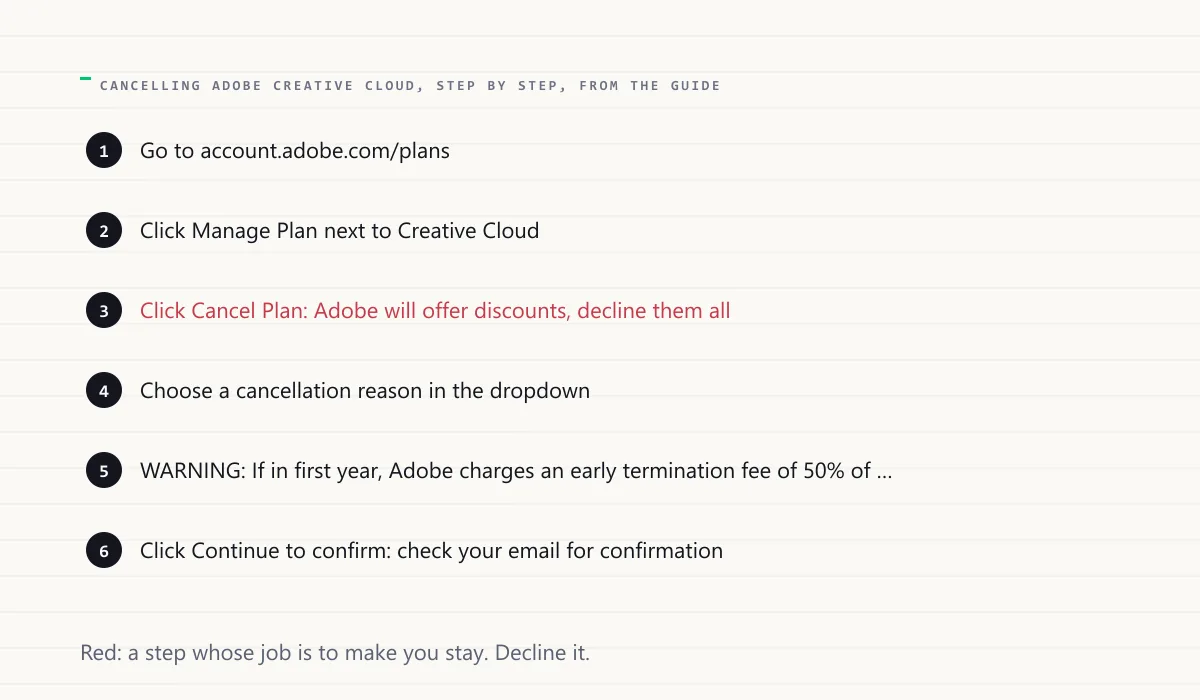
In alphabetical order within each group. Each name links to its guide, which has the steps and the direct link to the cancellation page.
- Adobe Creative Cloud (dark pattern)
- Adobe Firefly (dark pattern)
- Amazon Prime (dark pattern)
- Netflix (dark pattern)
- Tinder Gold (dark pattern)
- Beachbody (hard)
- Eight Sleep (hard)
- Equinox+ (hard)
- LifeLock (hard)
- McAfee Total Protection (hard)
- Monday.com (hard)
- Noom (hard)
- Norton 360 (hard)
- Weight Watchers (hard)
What they have in common
Three things appear again and again. The cancel link is not on the account page but a level below it, often under a name like Manage plan. There is at least one offer between you and the end, usually a discount for a few months, sometimes a free period, sometimes a cheaper tier. And the last screen asks whether you are sure, in a layout where the button that keeps the subscription is the big one.
None of this is illegal in most places, and some of it is being regulated. It works because people are busy. The offer looks reasonable, the pause looks kind, and the subscription is still there next month.
The hard group, as distinct from the dark-pattern group, is mostly about where the exit is. A membership that was started on a website may only end by phone during office hours, or by a chat that opens with a queue. A device bought with a subscription attached may need the account closed in one place and the plan in another. Nothing in those flows is a trick; they are simply long, and length is enough to make people put it off until after the next charge.
How the rating is decided
Each guide in the catalogue is written from the service's own cancellation page, step by step, and the rating follows from the steps: easy for a visible button and one confirmation, medium for several screens or a single offer, hard for a phone call, a chat, a letter, or a path with more than a handful of screens, and dark pattern when a step exists only to make you stay. When a service changes its flow, the guide is rewritten and the rating moves with it. The count at the top of this post moves too, because it is taken from the catalogue when the page is built.
How to get through
Three habits cover almost all of it.
- Decide before you start. You are cancelling. Every offer is a no, including the good ones; you can always come back at full price later if you miss it.
- Read the last screen. If it says paused, or your plan has been changed, or we have saved your settings, it is not cancelled. Go back and find the word cancel.
- Keep the confirmation and check the renewal date. Zeno marks a cancellation verified only when the date passes with no new charge in the receipts or statements you scan or import.
Where the numbers come from
Every figure in this post is counted from the catalogue when the page is built, not typed in, and the picture at the top is drawn from the same list. When a service changes its flow and the guide is updated, the counts here change with it.